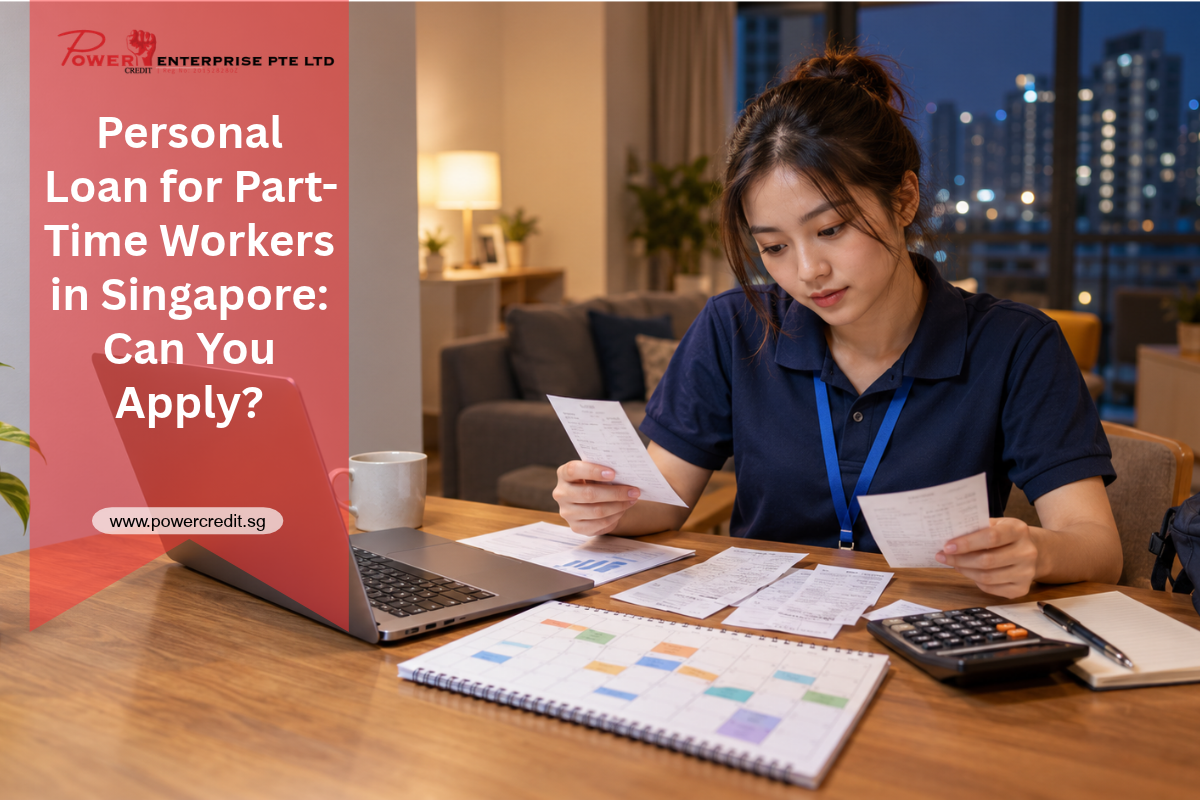
Part-time work provides flexibility for parents, students, semi-retired workers and people managing more than one job. However, fluctuating hours and variable monthly income can make loan applications more complicated.
Can you apply for a personal loan as a part-time worker in Singapore?
Yes, a part-time worker may submit a loan application. Your employment status does not automatically guarantee approval or rejection. A licensed moneylender will assess whether your income is genuine, sufficiently consistent and able to support the proposed repayments.
Your application will usually be stronger when you can provide several months of payslips, salary-crediting bank statements, employment documents and accurate information about your existing financial commitments.
This guide explains how part-time income is assessed, which documents may be required and how to choose an affordable repayment amount.
Key Takeaways
- Part-time workers may apply for personal loans in Singapore.
- Approval is subject to individual assessment and is never guaranteed.
- Several months of income records can help establish your normal earnings.
- Variable hours, overtime and allowances should be supported by documents.
- Singapore citizens and permanent residents working under a contract of service may receive CPF contributions when applicable.
- If you work for multiple employers, provide income records from every declared job.
- The legal maximum borrowing limit is not necessarily an affordable amount.
- Choose repayments based on a lower-income month rather than your highest earnings.
- Verify the lender through the official Registry of Moneylenders before applying.
Who Is Considered a Part-Time Employee in Singapore?
Singapore’s Ministry of Manpower defines a part-time employee as someone employed under a contract of service to work fewer than 35 hours per week.
A part-time employee’s contract should specify:
- Hourly basic rate of pay
- Hourly gross rate of pay
- Working hours per day or week
- Working days per week or month
Part-time employees are generally covered by the Employment Act, subject to the applicable exclusions.
Part-time workers may include:
- Retail assistants
- Food-and-beverage employees
- Administrative staff
- Tutors
- Healthcare support workers
- Warehouse assistants
- Event staff
- Weekend workers
- Semi-retired employees
- Students with lawful employment
- Employees holding two or more part-time jobs
A freelancer or self-employed person is not necessarily a part-time employee. A genuine part-time employee works under a contract of service, while a self-employed person generally provides services through their own trade or business.
Can Part-Time Workers Get a Personal Loan in Singapore?
A part-time worker may apply for a personal loan, but the lender must assess the application responsibly.
The lender may consider:
- Average monthly income
- Length of employment
- Number of working hours
- Frequency of salary payments
- Stability of working schedules
- Number of employers
- Existing debts
- Monthly living expenses
- MLCB repayment records
- Amount requested
- Proposed loan tenure
- Ability to repay during quieter months
No individual document guarantees approval. The lender evaluates the complete financial position before deciding whether a proposed loan is affordable.
Does Part-Time Employment Reduce Your Approval Chances?
Part-time employment alone does not determine the outcome. The main issue is usually whether the applicant can demonstrate sufficient and reasonably consistent income.
Consider two illustrative applicants:
| Applicant A | Applicant B |
|---|---|
| Employed for 12 months | Started two weeks ago |
| Regular weekly schedule | Hours change significantly |
| Six months of payslips | No payslip received |
| Salary appears in bank account | Mostly undocumented cash payments |
| Limited existing repayments | Several active loans |
| Requests a modest amount | Requests the statutory maximum |
Applicant A may present a clearer and more manageable application even though both applicants work part-time.
The approved amount can still be lower than requested. A responsible assessment should prioritise affordability rather than the largest possible loan.
What Documents Should a Part-Time Worker Prepare?
Requirements depend on the applicant’s income structure and residency status. Prepare as many relevant documents as possible.
Identity documents
Singapore citizens and permanent residents should prepare a valid NRIC or another accepted identity document.
Foreign applicants may need:
- Passport
- Valid work pass
- Proof of Singapore residential address
- Employment documents
- Income records
Employment contract
A part-time employment contract can establish:
- Employer’s name
- Job title
- Employment start date
- Hourly rate
- Expected working hours
- Salary period
- Contract duration
- Applicable allowances
The contract should be signed and consistent with the information supplied in the application.
Recent payslips
Provide several recent payslips where available.
Each payslip may show:
- Basic wages
- Total hours worked
- Overtime
- Allowances
- Deductions
- CPF contributions
- Net salary
- Pay period
A longer record makes it easier to distinguish normal income from an unusually high or low month.
Bank statements
Bank statements can verify that the declared wages were received.
A lender may review:
- Employer salary credits
- Frequency of payment
- Average income
- Existing loan deductions
- Regular household expenses
- Transfers between your own accounts
- Unexplained deposits
Salary payments should correspond reasonably with the supplied payslips.
CPF contribution history
CPF contributions may help support an applicant’s employment and income records.
CPF states that contributions are payable for eligible part-time, casual and temporary employees who are Singapore citizens or permanent residents, engaged under a contract of service and earning more than S$50 per month.
Foreign employees generally do not receive CPF contributions, so other income documents will be necessary.
Proof of residential address
Prepare an accepted document such as a recent:
- Utility bill
- Telephone bill
- Tenancy agreement
- Bank correspondence
- Government letter
IRAS Notice of Assessment
An IRAS Notice of Assessment may help provide a broader view of annual income, especially where the applicant has multiple income sources.
However, an older assessment might not accurately reflect a recent change in working hours or employment.
What If You Work for Multiple Employers?
Some part-time employees work two or more jobs.
For example, an applicant may work:
- Three weekdays in an administrative role
- Evening shifts in retail
- Weekend shifts at an event venue
If you declare income from multiple jobs, provide evidence for each one.
Prepare:
- Employment contracts
- Payslips
- Bank statements
- CPF contribution records
- Work schedules where relevant
- An explanation of how long each job has been held
Do not combine unrelated transfers and describe the total as salary. The lender must be able to identify the source and consistency of each income stream.
Example of combined income
| Income source | Average monthly amount |
|---|---|
| Administrative job | S$1,200 |
| Weekend retail job | S$650 |
| Regular event shifts | S$300 |
| Average total income | S$2,150 |
The applicant should not assume that every income source will automatically be counted in full. Short-term, irregular or undocumented income may be assessed differently.
How Is Variable Part-Time Income Calculated?
A part-time employee’s income may vary because of:
- Number of scheduled shifts
- Seasonal demand
- Overtime
- Public-holiday work
- Commissions
- Allowances
- Unpaid leave
- Medical leave
- Examination periods
- Business opening hours
A lender may review several months and calculate a reasonable average.
Example
| Month | Net income |
|---|---|
| January | S$1,850 |
| February | S$1,620 |
| March | S$2,050 |
| April | S$1,700 |
| May | S$1,900 |
| June | S$1,580 |
| Six-month total | S$10,700 |
| Monthly average | Approximately S$1,783 |
Although the average is about S$1,783, an affordability assessment should also consider whether the borrower could make repayments during a lower-income month such as June.
A conservative budget is safer than planning around the highest month.
Can You Apply With Only One Payslip?
You may submit an application, but one payslip might not provide enough information to establish stable income.
The lender may request:
- Employment contract
- Salary-crediting bank statement
- CPF contribution record
- Previous employment records
- Work schedule
- Additional payslips when available
If you only recently started the position, read Power Credit’s guide to getting a personal loan during probation in Singapore.
Waiting until several salary payments have been received may strengthen the application where the expense is not urgent.
Can You Apply if You Are Paid in Cash?
Cash wages can be more difficult to verify because they may not create a clear bank record.
Possible supporting evidence includes:
- Official payslips
- Signed employment contract
- CPF contribution history
- Employer-issued salary records
- Consistent cash deposits matching payslips
- IRAS income records
Do not manufacture receipts, deposit borrowed money to imitate salary or ask someone to falsely confirm employment. Incorrect information can result in rejection and other consequences.
Can Students With Part-Time Jobs Apply?
Holding a part-time job does not automatically qualify a student for a loan.
A lender may consider:
- Applicant’s age
- Employment status
- Income history
- Course commitments
- Remaining employment period
- Existing debts
- Ability to repay
- Residency or work-pass status
Students should consider education assistance, bursaries, school payment plans and family support before taking a commercial loan.
Borrowing for non-essential lifestyle spending may create repayments that continue after the temporary income has ended.
Can Semi-Retired Employees Apply?
A semi-retired person working part-time may apply, subject to assessment.
Relevant income documents may include:
- Part-time payslips
- Salary bank credits
- CPF records
- Employment contract
- Other lawful recurring income
- Existing repayment information
Savings are not necessarily a substitute for regular income. The lender must still determine whether the repayment schedule is manageable.
How Much Can a Part-Time Worker Borrow?
Part-time workers are subject to the same aggregate unsecured borrowing limits that apply to other borrowers.
These limits apply to the total outstanding unsecured amount across all licensed moneylenders—not separately to every lender.
The legal maximum is not a guaranteed loan amount. Your approved amount may be lower based on:
- Verified annual income
- Existing licensed-moneylender loans
- Income consistency
- Employment duration
- Monthly expenses
- MLCB records
- Proposed repayment schedule
The Ministry of Law’s official borrowing guide provides the applicable borrowing limits and regulated charges.
What Interest and Fees May Apply?
Licensed moneylenders in Singapore may charge within the regulated limits:
- Interest of up to 4% per month
- Late interest of up to 4% per month on the overdue amount
- An administrative fee of up to 10% of the principal when the loan is granted
- A late fee of up to S$60 for each month of late repayment
- Court-ordered legal costs for a successful recovery claim
The Ministry of Law confirms the 4% monthly interest cap, the S$60 monthly late-fee limit and the administrative-fee limit of 10% of principal.
The actual rate and repayment schedule must be stated in the loan contract.
Review Power Credit’s article explaining licensed moneylender interest rates in Singapore before accepting an offer.
Personal Loan or Payday Loan?
The appropriate option depends on the expense and repayment ability.
| Personal loan | Payday loan |
|---|---|
| Repaid through an agreed instalment schedule | Normally intended for a short gap before payday |
| May be more suitable for a larger necessary expense | Generally suited to a smaller, temporary shortfall |
| Requires budgeting across several payments | Requires confidence that the next salary can cover repayment |
| Should fit lower-income months | Should not depend on uncertain future shifts |
A payday loan may be unsuitable when:
- Your next pay amount is uncertain
- Your scheduled hours have been reduced
- You cannot repay from the next salary
- You repeatedly run short every month
- You are borrowing to repay another lender
For a defined expense requiring more than one repayment cycle, review Power Credit’s personal loan.
How to Check Whether Repayments Are Affordable
Begin with your lower normal income—not your best month.
Illustrative budget
| Item | Amount |
|---|---|
| Conservative monthly income | S$1,600 |
| Rent and utilities | −S$550 |
| Food | −S$350 |
| Transport | −S$180 |
| Family expenses | −S$150 |
| Existing repayments | −S$120 |
| Telephone and insurance | −S$100 |
| Remaining before new loan | S$150 |
In this example, the borrower has little room for another instalment.
Even if a loan is legally available, it may not be financially appropriate. The borrower should first consider whether the expense can be reduced, delayed or handled through a payment plan.
How to Strengthen Your Application
Approval cannot be guaranteed, but these steps can make your circumstances easier to assess.
Build a consistent income record
Where possible, prepare three to six months of payslips and bank statements.
Maintain one salary-receiving account
Using the same account for salary credits makes income patterns easier to identify.
Keep employment documents
Retain your contract, payslips, work schedules and employer correspondence.
Apply for the amount actually required
Calculate the exact expense rather than requesting the maximum permitted amount.
Declare all existing loans
Licensed moneylenders review relevant borrowing information through the Moneylenders Credit Bureau.
Read Power Credit’s guide to the MLCB report in Singapore.
Select a suitable repayment date
Where possible, the repayment date should correspond with your normal salary-credit schedule.
Keep a cash-flow buffer
Do not allocate all remaining income to an instalment. Your working hours or shift availability could change.
Alternatives to Consider Before Borrowing
Depending on the expense, consider:
- Payment arrangements with the service provider
- Employer salary advance
- Available savings
- Community or government assistance
- School financial-aid schemes
- Family assistance
- Postponing non-essential spending
- Increasing scheduled work hours where practical
- Selling unused possessions
- Reviewing subscriptions and discretionary expenses
A loan should solve a temporary need without creating a recurring shortage.
How to Apply Safely
Before sharing your personal data:
- Check the official Registry of Moneylenders.
- Confirm that the company name, website and office address match the registry.
- Do not respond to unsolicited SMS, WhatsApp or social-media offers.
- Never transfer an upfront fee before receiving a loan.
- Never provide your Singpass password.
- Attend the registered office for face-to-face verification.
- Read the completed contract before signing.
- Keep the contract and every repayment receipt.
Licensed moneylenders must conduct face-to-face verification at their approved place of business before granting a loan. They are also prohibited from soliciting borrowers through unsolicited calls, text messages and social-media messages.
Learn how to verify a licensed moneylender in Singapore.
Frequently Asked Questions
Can a part-time worker get a personal loan in Singapore?
A part-time worker may apply. Approval depends on verified income, employment stability, existing obligations and ability to repay.
How many payslips does a part-time worker need?
Requirements vary. Preparing three to six recent payslips and corresponding bank statements generally provides a clearer income history than one payslip.
Do part-time employees receive CPF contributions?
Eligible Singapore citizen and permanent resident employees working under a contract of service generally receive CPF contributions when they earn more than S$50 per month.
Can I combine income from two part-time jobs?
You may declare income from both jobs, but provide contracts, payslips and bank records for each employer. The lender will decide how the income is assessed.
Can I apply if my working hours change every month?
You may apply, but several months of records may be needed to determine a reasonable average. Assess affordability using a lower-income month.
Can I apply if I am paid weekly?
Yes, subject to assessment. Provide weekly payslips and bank records showing the wage deposits.
Can I apply without CPF records?
Some applicants, including eligible foreign employees, may not have CPF records. Alternative income evidence such as payslips, contracts and bank statements may be necessary.
Can a student with a part-time job apply?
Employment alone does not guarantee eligibility. Age, residency, income stability, existing debts and repayment capacity will be assessed.
Will the lender contact my employer?
The verification method depends on the application and documents. Ask before applying and read Power Credit’s guide on whether a licensed moneylender will contact your employer.
Does part-time work reduce my borrowing limit?
Your statutory limit depends on annual income and residency status. However, a lender may approve less after reviewing income stability and affordability.
Can I take a payday loan if my shifts are irregular?
Be cautious. A payday loan depends on sufficient income arriving by the repayment date. It may be unsuitable if the amount of your next salary is uncertain.
Final Thoughts
A personal loan for part-time workers in Singapore may be available when the applicant can demonstrate reliable income and afford the proposed repayments.
Prepare your employment contract, payslips, bank statements, CPF contribution history where applicable and records from every employer. Use a conservative income estimate and make sure the instalment remains manageable during a month with fewer shifts.
Power Credit Enterprise Pte Ltd assesses every application individually. Review the loan eligibility requirements or contact Power Credit to ask which documents apply to your employment arrangement.
This article provides general educational information and does not constitute financial advice. All loan applications remain subject to verification, assessment and approval.