A profitable business can still experience a cash-flow shortage.
Customers may take 30 or 60 days to pay invoices, while salaries, rent, supplier bills and inventory purchases remain due. A temporary timing gap can therefore disrupt an otherwise viable business.
A business cash flow loan in Singapore may help an eligible company cover a clearly defined short-term requirement while waiting for expected revenue.
However, borrowing should be supported by a realistic repayment source. Before accepting financing, determine exactly how much is needed, when incoming funds are expected and whether the business can still make repayments if revenue arrives later than planned.
This guide explains when business cash-flow financing may be useful, how to calculate the funding gap and what documents to prepare.
Quick Answer
A business cash-flow loan provides temporary funding for operational needs such as:
- Payroll
- Rent
- Supplier payments
- Inventory
- Equipment repairs
- Insurance
- Project mobilisation costs
- Gaps caused by unpaid customer invoices
It is most suitable when the funding need is temporary and the business can identify a credible repayment source.
It may be unsuitable when the company has continuing losses, no reliable incoming revenue or must repeatedly borrow to pay existing loans.
What Is Business Cash Flow?
Cash flow describes money entering and leaving a business.
Cash inflows may include:
- Customer payments
- Retail sales
- Project deposits
- Subscription revenue
- Rental income
- Business-owner capital
- Financing proceeds
Cash outflows may include:
- Employee salaries
- CPF contributions
- Rent
- Supplier invoices
- Inventory
- Utilities
- Insurance
- Taxes
- Equipment maintenance
- Loan repayments
Positive sales do not always produce positive cash flow immediately. A company may issue a S$30,000 invoice today but receive payment only 45 days later.
During those 45 days, the business must continue paying its operating expenses.
What Is a Business Cash Flow Loan?
A business cash-flow loan is financing used to meet short-term operating requirements.
Unlike financing intended to purchase a long-term property or major fixed asset, a cash-flow loan generally addresses a temporary difference between outgoing expenses and incoming business revenue.
Common examples include:
- Purchasing stock before a sales period
- Paying salaries while awaiting customer invoices
- Covering a supplier deposit for a confirmed project
- Repairing essential equipment
- Managing a temporary seasonal slowdown
- Funding mobilisation costs before a contract begins
- Paying annual insurance or licensing expenses
Power Credit Enterprise Pte Ltd provides information about its business loan in Singapore for eligible companies requiring working capital or business funding.
Cash-Flow Shortage Versus Business Loss
Before applying, determine whether the problem is a timing gap or a structural loss.
| Temporary cash-flow gap | Structural business loss |
|---|---|
| Confirmed revenue is expected later | Revenue consistently falls below expenses |
| Customer invoices are outstanding | There are few confirmed customers |
| A seasonal peak is approaching | Sales are declining without a recovery plan |
| Funding is required for a confirmed order | Borrowing is needed for normal expenses every month |
| The business can identify a repayment source | No realistic repayment source is available |
| The gap has a defined end date | The shortage continues indefinitely |
A loan may bridge a timing difference. It cannot make an unprofitable business sustainable by itself.
If the company repeatedly borrows to pay rent and payroll, management should review pricing, margins, expenses and the business model before adding more debt.
When Could a Business Cash Flow Loan Help?
Waiting for customer invoices
A company may have completed work but be waiting 30 to 60 days for payment.
Financing may help cover operating costs during the collection period, provided the invoice is genuine and the customer’s payment is reasonably expected.
Purchasing inventory
Retailers, restaurants and online sellers may need stock before a peak sales period.
The expected gross profit should be sufficient to cover:
- Inventory cost
- Loan cost
- Storage
- Delivery
- Unsold or damaged stock
- Other operating expenses
Starting a confirmed project
Some projects require an upfront payment for materials, subcontractors, transport or manpower before the customer makes a progress payment.
The business should examine the contract and project timeline carefully. A project that is delayed may also delay the repayment source.
Repairing essential equipment
A damaged commercial appliance, machine or vehicle may prevent the business from generating revenue.
Compare:
- Repair cost
- Time required
- Lost revenue during downtime
- Insurance coverage
- Replacement cost
- Financing cost
Managing seasonal revenue
Businesses in retail, hospitality, events and other seasonal industries may experience predictable changes in sales.
Use records from previous years rather than an optimistic forecast when estimating the expected recovery.
When Should a Business Avoid Borrowing?
A business should reconsider additional borrowing when:
- There is no clear purpose for the funds.
- Revenue forecasts are unsupported.
- Existing repayments are already difficult.
- The company regularly uses new loans to repay old loans.
- The requested amount exceeds the actual funding gap.
- The owner cannot distinguish business and personal expenses.
- The expected customer payment is disputed.
- The proposed project has no signed agreement.
- The company has outstanding tax, salary or statutory obligations it cannot address.
- The repayment relies entirely on an uncertain future sale.
- The loan cost would eliminate the project’s profit.
Borrowing more is not always the right solution. Expense reduction, supplier negotiation, customer deposits or equity funding may be more appropriate in some situations.
How to Calculate Your Business Funding Gap
Use a short-term cash-flow forecast.
Step 1: List the opening cash balance
Calculate how much usable cash is currently available in the company’s accounts.
Do not include restricted funds or money reserved for statutory obligations unless it is genuinely available.
Step 2: List expected cash inflows
Include only income reasonably expected during the forecast period:
- Confirmed customer payments
- Contract deposits
- Retail sales based on historical performance
- Refunds
- Other documented business receipts
Avoid including speculative sales.
Step 3: List essential outflows
Include:
- Payroll and CPF
- Rent
- Supplier payments
- Inventory
- Utilities
- Insurance
- Taxes
- Existing loan payments
- Project expenses
- Maintenance
- Emergency allowance
Step 4: Calculate the shortfall
Use this formula:
Opening cash + expected inflows − required outflows = projected cash position
If the result is negative, that amount represents the projected funding gap.
Business Cash-Flow Example
Consider an SME preparing for the next 30 days:
| Cash-flow item | Amount |
|---|---|
| Opening business cash | S$8,000 |
| Confirmed customer payment | S$15,000 |
| Expected retail sales | S$7,000 |
| Total available cash | S$30,000 |
| Payroll and CPF | −S$13,000 |
| Rent and utilities | −S$6,000 |
| Supplier payments | −S$8,000 |
| Inventory purchase | −S$7,000 |
| Existing repayment | −S$1,000 |
| Emergency allowance | −S$2,000 |
| Total required outflow | −S$37,000 |
| Projected funding gap | −S$7,000 |
The estimated gap is S$7,000.
The business should not automatically borrow a larger round figure such as S$15,000. It should first confirm whether expenses can be rescheduled and whether the expected customer payment is reliable.
This example is for educational purposes and is not a loan quotation.
Calculate Whether the Loan Can Pay for Itself
When financing is used for a revenue-generating purpose, compare expected gross profit with the financing cost.
Suppose a business needs S$10,000 to fulfil a confirmed order.
| Project calculation | Amount |
|---|---|
| Customer contract value | S$18,000 |
| Materials and supplier costs | −S$8,000 |
| Additional labour and delivery | −S$3,000 |
| Expected gross project profit | S$7,000 |
| Estimated financing and related costs | −S$1,200 |
| Remaining amount before overheads and tax | S$5,800 |
The business must still consider:
- Normal operating overheads
- Possible project delays
- Customer-payment risk
- Defects or rework
- Tax
- Other debt repayments
If the project margin is too small to absorb financing costs or delays, borrowing could turn the work into a loss.
Documents Commonly Required for a Business Loan
Requirements depend on the business structure and individual assessment.
Prepare a combination of the following:
Business registration records
- Current ACRA business profile
- UEN
- Incorporation or registration details
- Information about directors, shareholders or owners
Identification documents
- NRIC or passport
- Proof of residential address
- Relevant identification for directors, owners or guarantors
Financial records
- Recent business bank statements
- Profit-and-loss statements
- Balance sheet
- Cash-flow statement
- Latest financial accounts
- Relevant tax records
Revenue evidence
- Customer invoices
- Signed purchase orders
- Customer contracts
- Sales reports
- Merchant-terminal statements
- E-commerce platform records
- Project-progress claims
Expense evidence
- Supplier quotations
- Rental agreement
- Payroll records
- Equipment-repair quotation
- Inventory purchase orders
- Insurance renewal notice
Documents should be accurate and consistent. An ACRA profile proves that a business exists, but it does not by itself demonstrate the company’s ability to repay.
Why Business Bank Statements Matter
Bank statements show how money actually moves through the company.
A lender may review:
- Frequency of customer deposits
- Average monthly turnover
- Balance stability
- Existing loan deductions
- Returned payments
- Large unexplained transfers
- Regular operating expenses
- Whether income matches invoices and accounts
Keep business and personal transactions separate whenever possible.
Mixing household spending with company revenue can make the business’s actual performance difficult to assess.
How Is a Business Loan Assessed?
A lender may consider:
- Age and operating history of the business
- Business sector
- Monthly revenue
- Net cash flow
- Existing liabilities
- Bank-account conduct
- Purpose of financing
- Requested amount
- Proposed repayment period
- Directors’ or owners’ experience
- Supporting contracts or invoices
- Ability to continue repaying during a weaker month
Approval is not guaranteed.
A large sales figure also does not automatically demonstrate affordability. A business with S$100,000 in monthly sales but S$98,000 in expenses has less repayment capacity than one generating S$50,000 in sales with stronger margins.
Gross Revenue Is Not Available Cash
Gross revenue represents total sales before expenses.
Available cash is what remains after the business meets necessary commitments.
For example:
| Business performance | Amount |
|---|---|
| Monthly sales | S$60,000 |
| Cost of goods | −S$28,000 |
| Payroll and CPF | −S$15,000 |
| Rent and utilities | −S$7,000 |
| Transport and marketing | −S$4,000 |
| Existing repayments | −S$2,000 |
| Estimated amount before tax and contingencies | S$4,000 |
The company should assess repayment using the estimated S$4,000 margin—not the S$60,000 headline revenue.
Choosing an Appropriate Repayment Period
A shorter loan period may reduce the time over which borrowing costs accumulate, but repayments may be larger.
A longer period may reduce each scheduled payment but extend the company’s financial commitment.
Consider:
- Expected customer-payment dates
- Monthly fixed expenses
- Seasonal revenue changes
- Current loan repayments
- Minimum cash reserve
- How long the financed inventory will take to sell
- Whether the financed asset will generate revenue immediately
Do not build the repayment plan around the company’s best-ever month. Use conservative revenue assumptions.
Questions to Ask Before Accepting a Business Loan
Request a written breakdown showing:
- Loan principal
- Amount disbursed
- Interest rate
- Administrative or applicable fees
- Repayment dates
- Instalment amounts
- Total scheduled repayment
- Late-payment consequences
- Early-settlement procedure
- Security or guarantee requirements
- Whether directors or owners have personal liability
- What happens if the business closes
- Which documents will be issued
- How repayments will be recorded
Read every page before signing.
Power Credit’s loan-agreement checklist explains the principal, disbursement, repayment schedule and other contract terms borrowers should check.
Does the Three-Day Cooling-Off Period Apply to Business Loans?
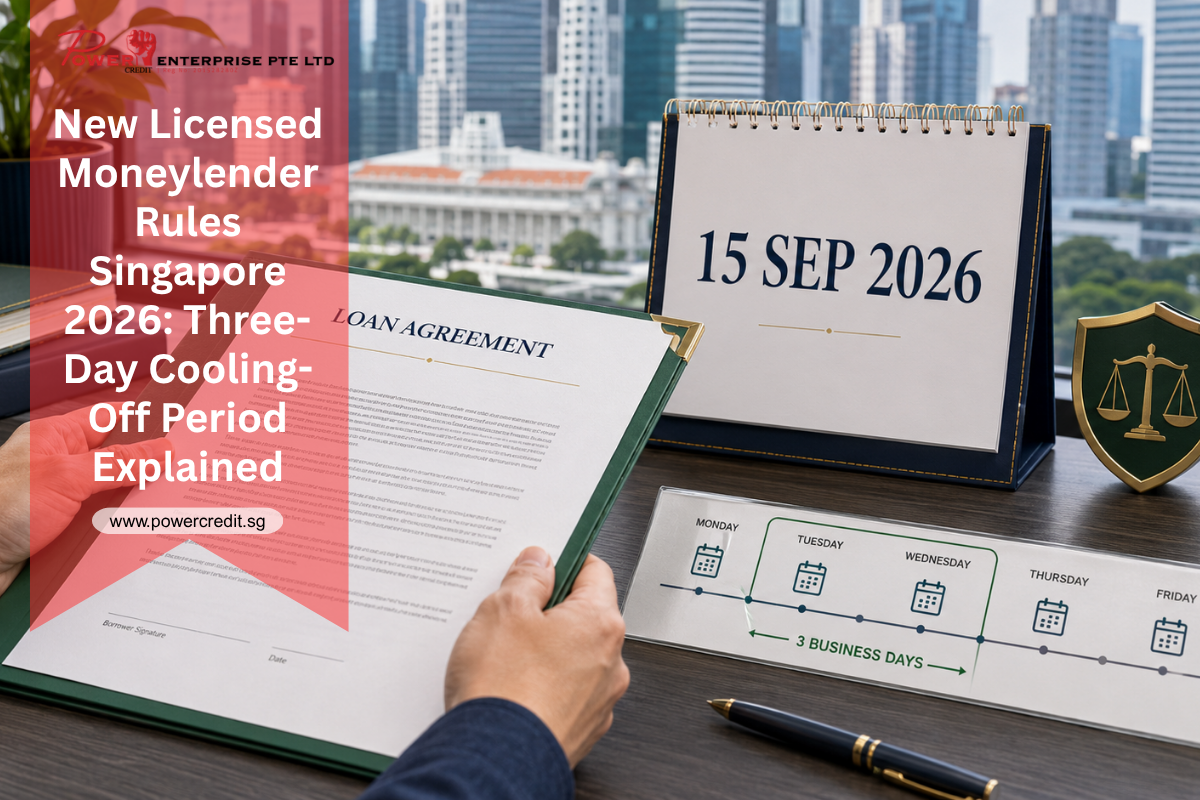
No. Singapore’s licensed-moneylender cooling-off period applies to unsecured loans other than business loans.
Eligible personal unsecured loans disbursed on or after 15 September 2026 receive a three-business-day cooling-off period, but business loans are expressly excluded.
Business owners should therefore review the financing carefully before signing instead of assuming it can be cancelled under the consumer cooling-off framework.
The cooling-off framework took effect on 15 September 2026.
Business Loan Versus Personal Loan
| Business loan | Personal loan |
|---|---|
| Intended for business-related expenses | Intended for personal or household expenses |
| Assessment may focus on company cash flow | Assessment focuses on individual income and commitments |
| Business records may be required | Payslips or personal income documents may be required |
| Borrower may be a business entity or individual, depending on structure | Borrower is an individual |
| May involve guarantees or security | Often unsecured |
| Consumer cooling-off period does not apply to business loans | May apply to eligible unsecured personal loans |
Do not apply for a personal loan while misrepresenting a business purpose or submit inaccurate company records for business financing.
If the expense is personal rather than commercial, review Power Credit’s personal loan information instead.
Business Loan Versus Invoice Financing
A cash-flow loan and invoice financing are not identical.
Business cash-flow loan
The business receives an agreed loan and follows a contractual repayment schedule.
Invoice financing
Funding is connected to qualifying unpaid customer invoices. Structures, eligibility and collection arrangements vary between providers.
Compare:
- Total cost
- Security
- Personal guarantees
- Repayment timing
- Customer-invoice requirements
- Administrative obligations
- Consequences of late customer payment
The appropriate option depends on why the cash shortage exists.
Business Loan Versus Equity Funding
Debt financing must be repaid. Equity funding generally involves giving an investor ownership or economic participation in the company.
| Debt financing | Equity funding |
|---|---|
| Repayment is required | Normally no scheduled loan repayment |
| Interest or financing costs may apply | Investor receives ownership or agreed rights |
| Existing owners may retain more control | Ownership may be diluted |
| Suitable for a defined, repayable requirement | May suit longer-term growth with uncertain returns |
| Creates a fixed financial obligation | Can create long-term governance obligations |
For a temporary invoice delay, debt may be more relevant. For a high-risk expansion with no predictable revenue, equity may be more appropriate.
Alternatives to Consider Before Borrowing
A loan should not automatically be the first solution.
Consider whether the business can:
- Request a customer deposit
- Negotiate milestone billing
- Shorten customer-payment terms
- Offer an early-payment discount
- Negotiate longer supplier terms
- Reduce slow-moving inventory
- Sell unused equipment
- Delay a non-essential purchase
- Use retained earnings
- Obtain an owner capital injection
- Apply for suitable bank or government-supported financing
- Renegotiate existing repayment terms
Compare the cost, timing and obligations of each option.
Warning Signs of an Unlicensed Lender
Be cautious if someone:
- Sends an unsolicited loan offer through WhatsApp, SMS or social media
- Guarantees approval without reviewing business records
- Requests GST, processing or verification payments before disbursement
- Uses a personal bank account
- Asks for Singpass or Corppass passwords
- Refuses to provide a written contract
- Pressures the business owner to sign immediately
- Uses an address that does not match the official registry
- Requests remote access to a computer or bank account
- Cannot explain the repayment calculation
The Registry of Moneylenders has warned that scammers may imitate licensed companies and request advance transfers described as GST or processing fees.
Verify the lender independently using the Registry’s official list.
Power Credit Enterprise’s homepage provides information about its services as one of the licensed money lenders in Singapore.
Frequently Asked Questions
What is a business cash-flow loan in Singapore?
It is financing used to cover a temporary gap between business expenses and expected revenue. Common uses include payroll, inventory, supplier payments and project mobilisation costs.
Can an SME apply for a business cash-flow loan?
An SME may apply, but approval depends on its operating history, cash flow, documentation, existing liabilities, purpose of financing and repayment capacity.
What documents are required?
Common documents include an ACRA business profile, directors’ identification, business bank statements, financial records, invoices, contracts and evidence supporting the funding purpose.
Can a new business qualify?
A short operating history may make revenue and repayment capacity more difficult to verify. Additional evidence, security or guarantees may be requested, and approval is not guaranteed.
How much should a business borrow?
Borrow only the amount required to address the verified cash-flow gap, including a reasonable contingency. Do not automatically apply for the maximum amount available.
Can a business loan be used for payroll?
Business financing may be used for legitimate operating expenses such as payroll, subject to the lender’s assessment and the contract terms.
Does the three-day cooling-off period apply?
No. The licensed-moneylender cooling-off period does not apply to business loans.
Is business revenue the same as repayment capacity?
No. Repayment capacity depends on the money remaining after cost of goods, payroll, rent, taxes, existing repayments and other operating expenses.
Will a business loan require a personal guarantee?
That depends on the business structure, lender and financing terms. Ask whether directors or owners will have personal liability before signing.
Can a sole proprietor apply?
A sole proprietor may apply subject to assessment. The lender may request business-registration, tax, banking and income documents.
How can a business avoid over-borrowing?
Prepare a conservative cash-flow forecast, identify the exact funding gap and test whether repayments remain affordable if revenue is delayed.
Final Thoughts
A business cash flow loan in Singapore may help an SME manage a temporary working-capital shortage, but it should be connected to a clear purpose and realistic repayment source.
Calculate the funding gap using confirmed inflows and essential outflows. Do not rely on gross revenue or optimistic sales projections. Review how the repayment would affect payroll, rent, suppliers and the company’s emergency reserve.
Before signing, confirm the principal, disbursement, financing cost, repayment dates, guarantees and total amount payable.
Power Credit Enterprise Pte Ltd provides business-loan assessments based on the applicant’s documents, funding purpose and repayment capacity. Review Power Credit’s business loan service or contact Power Credit for clarification about the application requirements.
This article provides general educational information and does not constitute financial, tax or legal advice. Business-loan applications are subject to assessment, verification, applicable regulations and approval.