A loan agreement is more than a form confirming how much money you want to borrow. It establishes the principal, amount disbursed, interest, fees, repayment dates and consequences if a payment is late.
Before signing a licensed moneylender loan agreement in Singapore, make sure every section is complete and has been explained in a language you understand.
Do not sign based only on the monthly instalment or amount advertised. Ask for the full repayment schedule and confirm how much money you will actually receive after the administrative fee.
This guide provides a practical checklist for reviewing a licensed moneylender’s Note of Contract before accepting a loan.
Quick Contract Checklist
Before signing, confirm these 12 items:
- The lender’s identity and registered business address
- Your personal details
- The loan principal
- The administrative fee
- The amount actually disbursed
- The monthly interest rate
- How interest is calculated
- Every repayment amount and due date
- The total scheduled repayment
- Late interest and late fees
- The applicable cooling-off terms
- Your copy of the completed contract
Never sign a blank or incomplete document.
The Ministry of Law states that a licensed moneylender must explain the loan terms in a language the borrower understands and provide the borrower with a copy of the contract.
What Is a Licensed Moneylender Loan Agreement?
A licensed moneylender loan agreement, commonly referred to as a Note of Contract, records the legally binding terms agreed between the lender and borrower.
It normally identifies:
- The licensed moneylender
- The borrower
- The loan principal
- Interest rate
- Applicable fees
- Amount disbursed
- Repayment schedule
- Late-payment consequences
- Rights and responsibilities of both parties
Once you sign and accept the loan, you are generally required to follow its terms unless you validly exercise an applicable legal right, such as the cooling-off cancellation available for eligible loans.
Take enough time to understand the document. Urgency should not prevent you from checking the figures.
Verify the Licensed Moneylender First
Before reviewing an offer, verify that the business is included on the Registry of Moneylenders’ official list.
Check that the following information matches:
- Company name
- Licence details
- Registered business address
- Official telephone number
- Official website address
Scammers may impersonate genuine licensed companies using similar websites, copied logos and familiar company names.
The Registry has warned that scammers may contact individuals through SMS or WhatsApp, create imitation websites, and request money described as processing fees or GST before disbursement.
Do not rely only on a messaging profile, advertisement or search result. Verify the business through the official Registry list and contact the company using information published on its genuine website.
Power Credit Enterprise Pte Ltd provides its registered contact information on its Contact Us page.
1. Check Your Personal Information
Read every personal-information field before signing.
Check your:
- Full legal name
- NRIC, FIN or passport details
- Residential address
- Employment information
- Income
- Contact details
- Bank information, where applicable
If information is wrong, request a corrected contract.
Even a simple error involving annual income, address or identification details should be corrected before signing. Do not accept a verbal assurance that the information will be changed afterward.
2. Confirm the Loan Principal
The principal is the contractual loan amount before interest and fees.
Do not confuse it with:
- The amount requested
- The amount approved verbally
- The amount you receive
- Total repayment
- Monthly instalment
For example, if a contract states a principal of S$5,000, the borrower may receive less than S$5,000 after the permitted administrative fee is deducted.
The contract should state the principal clearly and consistently.
3. Check the Administrative Fee
A licensed moneylender may impose an administrative fee of up to 10% of the principal when the loan is granted.
For a S$5,000 principal:
| Item | Illustrative amount |
|---|---|
| Principal | S$5,000 |
| Administrative fee at 10% | S$500 |
| Net amount received | S$4,500 |
The administrative fee is a maximum limit, not a compulsory rate for every loan.
Ask:
- What percentage will be charged?
- What is the exact fee in dollars?
- Will it be deducted from the principal?
- How much will I receive after deduction?
Do not calculate affordability based only on the net amount received. Your repayment obligation is connected to the contractual principal and agreed terms.
4. Confirm the Net Disbursement
The net disbursement is the amount you actually receive.
Before signing, compare these three figures:
| Figure | Meaning |
|---|---|
| Principal | Contractual loan amount |
| Administrative fee | Upfront permitted deduction |
| Net disbursement | Money actually received |
If you need S$4,000 for a specific expense, a principal of S$4,000 may provide less than the amount required after the administrative fee.
Ask the loan officer to write down the exact disbursement amount before you proceed.
After disbursement, verify that the amount received matches the contract and receipt.
5. Review the Interest Rate
Licensed moneylenders may charge interest of up to 4% per month.
The cap applies regardless of:
- Borrower income
- Citizenship or residency
- Whether the loan is secured or unsecured
Interest must be calculated using the outstanding principal after payments allocated to principal have been deducted.
For example:
| Outstanding principal | Interest at 4% for one month |
|---|---|
| S$5,000 | S$200 |
| S$4,000 | S$160 |
| S$3,000 | S$120 |
| S$2,000 | S$80 |
This simplified illustration assumes the maximum rate and a monthly calculation. Your actual schedule depends on the rate and terms offered.
Ask the lender:
- What is the monthly interest rate?
- Is interest calculated daily, weekly or monthly?
- What balance is used?
- How much scheduled interest will I pay?
- How does each payment reduce the principal?
6. Read the Complete Repayment Schedule
A repayment schedule should identify:
- First payment date
- Every subsequent due date
- Instalment amount
- Payment frequency
- Number of repayments
- Final repayment date
- Total scheduled repayment
Check whether the schedule fits your actual income dates.
If your salary is paid on the final working day of each month, a payment due several days earlier may create a recurring cash-flow problem.
Do not select a schedule based only on the smallest instalment. A longer tenure may reduce each payment but can increase the period during which interest accrues.
Power Credit’s personal loan information explains its structured financing option for personal expenses, subject to assessment.
7. Calculate the Total Repayment
The monthly instalment alone does not show the full borrowing cost.
Calculate:
Total of scheduled instalments + applicable upfront fee
Then compare that figure with the money you actually receive.
Illustrative comparison
| Item | Loan example |
|---|---|
| Principal | S$3,000 |
| Administrative fee | S$300 |
| Net disbursement | S$2,700 |
| Total scheduled instalments | S$3,480 |
| Total amount paid, including upfront fee | S$3,780 |
| Difference between net amount received and total paid | S$1,080 |
This is an educational example only. It is not a quotation from Power Credit and does not represent a particular repayment structure.
Ask the lender for an account-specific calculation before signing.
8. Understand Late Interest
If you miss a payment, a licensed moneylender may charge late interest of up to 4% per month.
Late interest may be calculated only using the amount that is overdue.
For example, suppose:
- Current instalment: S$500
- Future instalments not yet due: S$1,500
If the S$500 payment is late, late interest may apply to the overdue S$500—not automatically to the future S$1,500.
The contract should explain the late-interest rate and when it begins to apply.
9. Understand the Late Fee
A licensed moneylender may impose a fee of up to S$60 for each month of late repayment.
The S$60 amount is a statutory ceiling rather than a mandatory charge.
Check:
- The stated late fee
- When it becomes payable
- Whether it applies for each month of late repayment
- How the lender defines a late month
- How late payments are allocated
Paying late may result in both late interest on the overdue amount and a permitted monthly late fee.
Contact the lender before the due date if you expect difficulty making a repayment.
10. Check the Overall Cap on Interest and Fees
The combined amount of:
- Regular interest
- Late interest
- Administrative fee
- Late fees
cannot exceed an amount equivalent to the original principal.
If the principal is S$5,000, these combined charges cannot exceed S$5,000.
This does not mean the borrower’s total payment is capped at S$5,000. The principal must still be repaid. In this example, principal plus capped charges could total up to S$10,000, excluding court-ordered legal costs.
The cap is a legal safeguard, not a target cost.
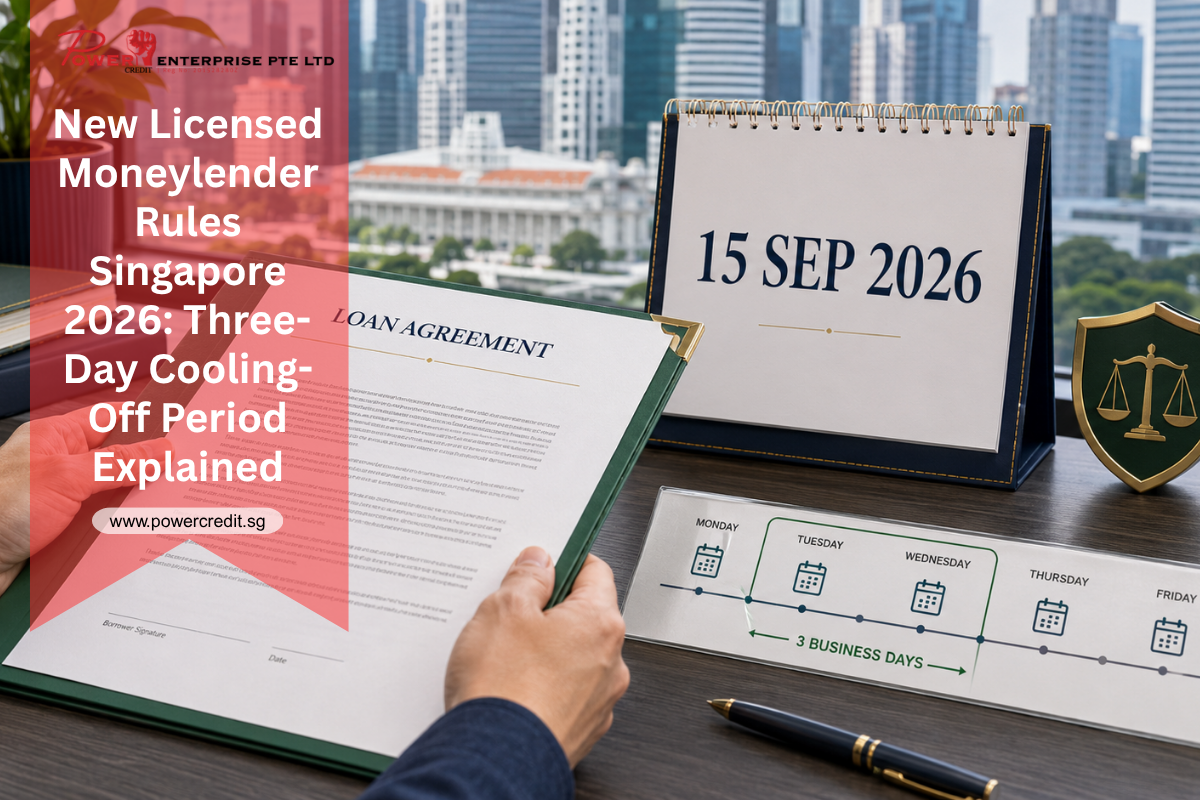
11. Review the Three-Business-Day Cooling-Off Period
From 15 September 2026, eligible unsecured loans—other than business loans—granted by licensed moneylenders are subject to a three-business-day cooling-off period.
The disbursement date is not counted. Saturdays, Sundays and Singapore public holidays are also excluded.
During the cooling-off period, an eligible borrower may cancel the loan by completing the required cancellation process and repayment.
No interest is charged for a valid cooling-off cancellation. The licensed moneylender may retain only the permitted portion of the loan-approval fee:
| Loan principal | Maximum approval fee retainable |
|---|---|
| S$5,000 and below | Up to S$50, not exceeding the fee paid |
| More than S$5,000 | Up to 3.5% of principal, not exceeding the fee paid |
The total amount repaid for cancellation must not exceed the principal.
The cooling-off period applies to qualifying loans disbursed on or after 15 September 2026.
Ask for written instructions explaining:
- When the cooling-off period begins
- When it ends
- How cancellation must be communicated
- Where repayment must be made
- What confirmation you will receive
12. Check Early-Settlement Terms
If you may repay the loan before the scheduled end date, ask:
- How do I request a settlement quotation?
- How is interest calculated up to the settlement date?
- How long is the quotation valid?
- Which payment method must be used?
- Will I receive written zero-balance confirmation?
Power Credit states that it does not impose an early-repayment penalty. Nevertheless, request an account-specific settlement quotation before transferring payment.
Do not estimate the settlement amount yourself.
13. Examine Any Security or Property-Related Terms
Read particularly carefully if the contract contains a term allowing the lender to lodge a caveat against sale proceeds from real estate following a default.
The Ministry of Law warns borrowers to consider such clauses carefully because a caveat may prevent the property from being sold until the moneylender has been repaid.
If you do not understand a property-related clause, obtain independent legal advice before signing.
14. Confirm the Loan Purpose and Product
Make sure the selected product matches the intended use.
Power Credit’s loan services include:
- Personal loans for eligible personal expenses
- Payday loans for temporary cash-flow gaps
- Foreigner loans for eligible foreigners residing in Singapore
- Business loans for business funding requirements
- Debt consolidation loans for eligible borrowers seeking to combine debts
Do not misrepresent how funds will be used or provide inaccurate documents.
Approval, amount, interest and repayment structure remain subject to assessment.
15. Do Not Sign a Blank or Incomplete Contract
Never sign a contract when:
- Important figures are missing
- Repayment dates are blank
- Fees are not stated
- Pages are missing
- Corrections have not been initialled or confirmed
- The loan officer has not explained the terms
- You are told details will be completed later
- You are prevented from reading the document
- You are asked to provide your Singpass password
The Ministry of Law specifically identifies signing a blank or incomplete Note of Contract as an unacceptable practice.
Ask for a corrected and complete document.
16. Obtain Your Copy and Keep Every Receipt
After signing, obtain your copy of the completed contract and repayment schedule.
For every repayment:
- Request an official receipt.
- Check your name.
- Check the payment amount.
- Check the date.
- Check the loan reference.
- Retain proof of the payment method.
Borrowers should also receive statements of account at least once every January and July and should check them for accuracy. The Ministry of Law recommends retaining statements and receipts as documentation and evidence of payments.
Maintain a dedicated folder containing:
- Loan contract
- Repayment schedule
- Disbursement receipt
- Payment receipts
- Statements of account
- Settlement quotation
- Loan-closure confirmation
- Relevant correspondence
Questions to Ask the Loan Officer
Use these questions during the contract explanation:
- What is the principal?
- What amount will I receive?
- What administrative fee is charged?
- What is the monthly interest rate?
- How is interest calculated?
- How much is every repayment?
- When is each payment due?
- What is the total scheduled repayment?
- What happens if a payment is late?
- How are payments allocated between interest and principal?
- Does the cooling-off period apply?
- How do I cancel within the cooling-off period?
- How do I request early settlement?
- Will I receive a receipt for every payment?
- Who should I contact if I have repayment difficulty?
Ask for written clarification if an answer affects the amount payable.
Red Flags Before Signing
Stop and verify the offer if someone:
- Sends an unsolicited loan advertisement through WhatsApp, SMS or social media
- Guarantees approval without assessment
- Requests a transfer before disbursement
- Asks for your Singpass password
- Refuses to meet you at the registered office
- Wants to complete the entire loan remotely
- Uses a personal bank account for payment
- Retains your NRIC, passport, work pass or ATM card
- Pressures you to sign an incomplete document
- Refuses to provide a contract copy
- Cannot explain the repayment calculation
- Charges a fee that is not identified clearly
Licensed moneylenders may advertise only through their own websites, business or consumer directories, and advertisements at their approved premises. Unsolicited loan advertisements through other channels should not be trusted.
Frequently Asked Questions
What should a licensed moneylender loan agreement contain?
It should identify the lender and borrower and state the principal, interest, fees, amount disbursed, repayment schedule and late-payment consequences. All fields should be complete before signing.
Is the loan principal the amount I receive?
Not necessarily. An administrative fee of up to 10% of the principal may be deducted when the loan is granted, resulting in a lower net disbursement.
What is the maximum licensed moneylender interest rate?
The maximum regular interest rate is 4% per month, calculated using the outstanding principal.
What is the maximum late-payment fee?
A licensed moneylender may charge up to S$60 for each month of late repayment.
Can late interest be imposed on the entire loan balance?
Late interest may be imposed only on the amount that is overdue, rather than future instalments that have not yet become payable.
Must the loan terms be explained to me?
Yes. The lender must explain the contract in a language you understand and provide you with a copy of the completed agreement.
Can a licensed moneylender keep my NRIC?
No. Do not allow a lender to retain your NRIC, passport, work pass, ATM card or other personal identification document.
Can I complete the entire loan online?
An online form may begin an application, but a licensed moneylender must conduct the required identity verification at its approved business premises before granting the loan.
Can I cancel after signing?
Eligible unsecured loans other than business loans disbursed on or after 15 September 2026 have a three-business-day cooling-off period. You must complete the required cancellation and repayment process within the applicable period.
What records should I keep?
Keep your contract, repayment schedule, disbursement record, payment receipts, statements of account, settlement documents and correspondence.
Final Thoughts
A licensed moneylender loan agreement in Singapore should make the complete borrowing cost understandable before you sign.
Confirm the principal, administrative fee, net disbursement, interest rate, repayment dates, total repayment and late-payment consequences. Read the cooling-off provisions and obtain a copy of every completed document.
Most importantly, do not sign a blank agreement or rely solely on a verbal promise.
Power Credit Enterprise Pte Ltd explains its loan terms and repayment structure before a borrower enters into an agreement. Review Power Credit’s loan eligibility requirements or contact Power Credit if you require clarification about an application.
For an overview of Power Credit’s regulated services, visit the homepage for information about licensed money lenders in Singapore.
This article is for general educational purposes and does not constitute legal or financial advice. Every application and loan offer is subject to verification, assessment, applicable regulations and the signed contract.